> For the complete documentation index, see [llms.txt](https://docs.vultisig.com/llms.txt). Markdown versions of documentation pages are available by appending `.md` to page URLs; this page is available as [Markdown](https://docs.vultisig.com/app-guide/creating-a-vault/secure-vault.md).
# Vultisig Secure Vault
Vultisig Secure Vault: seedless crypto wallet across your own devices, no server co-signer. 2-of-2 up to m-of-n. For larger holdings.
## Overview
Every share sits on a device you hold. No VultiServer. You need at least two devices. Add more if you want a fallback when one is gone.
{% hint style="info" %}
Shared control: each person holds a device share. Same pattern for a DAO or a two-person treasury.
{% endhint %}
***
## Threshold Configurations
Secure Vaults use an `m`-of-`n` threshold where `m` is at least 67% of `n`. Common configurations:
| Setup | Devices | Signing | Redundancy | Recommendation |
| ---------- | ------- | ------- | -------------- | ---------------- |
| **2-of-3** | 3 | 2 | Yes (1 device) | **Recommended** |
| **3-of-4** | 4 | 3 | Yes (1 device) | Higher threshold |
| **2-of-2** | 2 | 2 | No | Not recommended |
{% hint style="info" %}
**Split backups across platforms:**
1. Use 3 different platforms (Mac, iOS, Android)
2. Encrypt vault shares with 3 different passwords
3. Store shares in 3 different cloud providers (Google, iCloud, Dropbox)
4. Use unique email addresses with 2FA for each cloud account
This setup allows recovery from anywhere in the world with just email access and passwords—no hardware wallets or seed phrases required.
{% endhint %}
***
## Creation Steps
**Requirements:**
* One initiating device
* One or more pairing devices
### On the Initiating Device
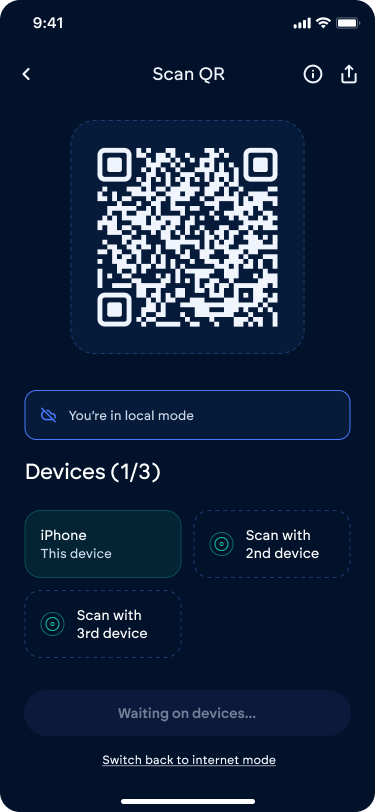
1. Select **Secure Vault** option
2. Choose a vault name
3. A QR code will appear for pairing devices
### On Pairing Devices
4. Select **Scan QR code** and scan the initiating device's QR
### Complete Setup
5. When all devices are connected, tap **Next** on the initiating device
6. Wait for keygen to complete on all devices
***
## Network Options
| Mode | Description | Use Case |
| ------------ | -------------------------- | -------------------------------------- |
| **Internet** | Uses Vultisig relay server | Devices on different networks |
| **Local** | Uses local WiFi (mDNS) | Same network, may not work on all WiFi |
***
## After Creation
{% hint style="warning" %}
**Export a backup from every device before you deposit.**
A lost device with no backup means the funds are gone. [Backup & Recovery](/getting-started/backup-recovery.md)
{% endhint %}
---
# Agent Instructions
This documentation is published with GitBook. GitBook is the documentation platform designed so that both humans and AI agents can read, navigate, and reason over technical content effectively. Learn more at gitbook.com.
## Querying This Documentation
If you need additional information that is not directly available in this page, you can query the documentation by asking a question.
Perform an HTTP GET request on the following URL with the `ask` and `goal` query parameters:
```
GET https://docs.vultisig.com/app-guide/creating-a-vault/secure-vault.md?ask=&goal=
```
`ask` is the immediate question: it should be specific, self-contained, and written in natural language.
`goal` is what the user is ultimately trying to achieve, the reason they need the answer. Sharing it helps GitBook give you a better, more relevant answer. A goal is most helpful when it describes the outcome the user wants rather than restating the question. For example, with `ask=how do I create an API token`, a goal like `automate deployments from our CI pipeline` lets GitBook tailor the answer to that use case.
The response will contain a direct answer to the question and relevant excerpts and sources from the documentation.
Use this mechanism when the answer is not explicitly present in the current page, you need clarification or additional context, or you want to retrieve related documentation sections.
.png?alt=media)
.png?alt=media)
.png?alt=media)
.png?alt=media)
.png?alt=media)
.png?alt=media)